THE TUNNEL | The Space Between Clarity
There is a particular kind of disorientation that doesn't get talked about enough. It isn't depression, although it can feel heavy. It isn't a crisis, although it can feel destabilising. It isn't failure, although it can feel that way from the inside. And it isn't purposelessness — it’s purpose narrowed to the present step, without being able to see where you're going.
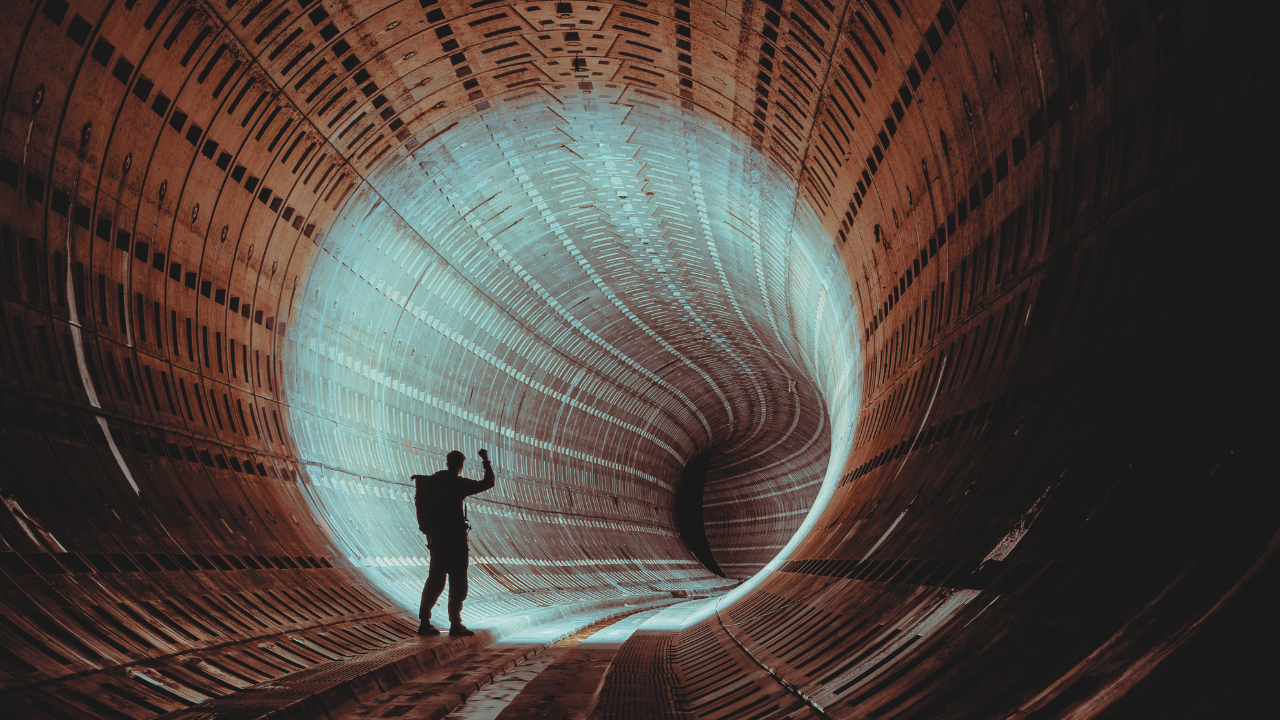
It’s the tunnel. The space between who you were and who you are becoming. The place you find yourself when the old version of yourself no longer fits — but the new one hasn't arrived yet.
If you're in it right now, you'll recognise it immediately. If you've been through it, you'll remember it clearly. And if you haven't experienced it yet, you probably will — because it's one of the most universal and least discussed passages of a human life.
I know this tunnel. From the lived experience of an extended stay. Long enough to know it very well, and to have something honest to say about it.
What the tunnel feels like
The tunnel has a particular quality that makes it hard to name and navigate. From the outside, nothing may look dramatically wrong or different. You're still functioning, showing up, and doing the things you're supposed to do — even if something is subtly quieter, and a little less than it used to be. You may not be entirely hiding, but you are less visible. There may not be a complete withdrawal, but there is often a temporary dimming.
Inside you, something has shifted. The things that once felt certain no longer feel certain. The identity that once felt solid has become strangely loose. The message you used to deliver with confidence now catches in your throat. The path that once seemed clear and stable has become harder to see and walk.
Self-doubt moves in. Not the passing self-doubt that visits and leaves, but a deeper, more persistent kind. The kind that asks: Who am I now? What do I believe? What do I want to do? What do I actually have to offer? Does any of this still make sense?
The tunnel can last months. For some people, years. The duration can look like a sign that something has gone wrong. But it is a sign that what is being formed is genuine — and genuine things take the time they take.
And perhaps most disorienting of all: the sense that you are no longer what you were — but you haven't yet become what life is calling you toward. You are suspended between two versions of yourself. And that suspension, for many people, is one of the most paralysing places a human being can find themselves.
How you end up here
The tunnel usually follows growth — which is one of the reasons it's so confusing. You would expect growth to feel expansive, confident, even exciting. And sometimes it does. But real growth — the kind that changes not just what you know but who you are — often involves outgrowing something first.
A way of working that once felt alive begins to feel thin, or even a bit boring. A message that once resonated begins to feel stale or borrowed. A community, a method, an identity — something that once provided structure and certainty — starts to feel like it belongs to an earlier version of you. Sometimes entirely, sometimes in parts. And you realise that you cannot go back and stay authentic. The past wasn’t wrong, but you have changed.
That recognition is the entrance to the tunnel.
What has been is clear. What is becoming is not yet. And in between — in that gap between the old certainty and the new — the tunnel begins.
What the tunnel asks of you
The instinct in the tunnel is to find the exit as quickly as possible. To manufacture clarity. To pick a direction — any direction — just to end the disorientation and to escape the uneasy feeling. To return to what felt certain even if it no longer feels completely true, or you. Or to perform clarity and confidence you don't yet fully feel, hoping it will eventually become real.
These responses are entirely understandable — they are what the tunnel asks of us instinctively, and they are part of feeling your way through it. In fact, they can provide glimpses of clarity and help you begin to discover something new. But none of them are the way out in themselves. And most of them, if held onto too long, make the tunnel longer.
What the tunnel actually asks of you is harder and simpler than any of that. It asks you to stay with the not-yet-knowing. To resist the urge to force a conclusion before the understanding has arrived. To choose patience over pressure to know now. To trust, even without evidence, that the disorientation is not proof of a problem — but part of a process.
If the clarity you seek isn’t here yet, it usually means you’ve got more life to live. More to learn and unlearn. The tunnel asks you to keep doing the inner work even when you can't see where it's leading. To keep showing up even when the response is quieter than it used to be. To keep asking honest questions even when the answers aren't yet available, or fully formed. To stay true to yourself, even when you’re not yet sure what that fully means.
The tunnel asks you to keep putting one foot in front of the other, even if you cannot see where you are going, yet.
What the tunnel is actually doing
The tunnel is a necessary passage between one genuine version of yourself and the next. It can feel like punishment, failure, stagnation, or being lost. But that is the tunnel talking — not the truth.
The old certainty needed to loosen before the new understanding can form. This might be a belief you've held about yourself for years, a relationship that once defined you, a career that gave you a sense of purpose, or a community that shaped how you saw the world. The framework needed to fall away before an updated one can emerge. The identity that no longer fits — the role, the title, the version of yourself you've been presenting to the world — needed to be released before the truer one can be born.
Something real is happening in the tunnel — even when, especially when, it doesn't feel like it. The discomfort is real, and the work being done beneath it is equally real.
The tunnel doesn't require you to stop everything that came before, or to sit on your couch until clarity knocks on your door. It involves your active participation and asks you to show up differently within it. Sometimes external things change. The internal always does. The clarity that arrives on the other side of the tunnel is different in quality from the clarity that preceded it. It is harder won, more honestly held, and more truly yours. It isn’t borrowed or performed. It has been lived into.
The temptation to go back
At some point in the tunnel — often more than once — the old version of yourself will begin to look very appealing. It was known and familiarity has that effect. It had a shape you could recognise, a language you could speak with confidence, a framework that worked. People responded. Life felt more legible.
Standing in the disorientation of the tunnel, that legibility can feel like everything.
The pull rarely announces itself as retreat or compromise. It arrives disguised as practicality — as sensible thinking, as pragmatism, as self-care, as temporary strategy. There can be reduced revenue. There can be a loss of audience or following. There can be relational pressures — including people who preferred who you were. And there can be moments of genuine doubt about whether staying in the tunnel is worth it. It whispers things like: Just for now. This is the practical thing to do. Just go back to what worked. Just teach what you know. Just be who you were — at least until things settle down. It sounds reasonable. And for a while, it can be hard to hear anything else.
And sometimes it comes as nostalgia — a romanticising of the previous version of yourself that conveniently forgets why you outgrew it in the first place.
Staying in the tunnel rather than going back requires a particular kind of fortitude — not the loud, visible courage of bold action, but the quieter, steadier courage of refusing to betray what you know is right. Of staying with the authentic even when the familiar is right there, offering relief.
Let’s call it what it is: integrity. If you have stayed in the tunnel rather than retreating to a former self that no longer fits — resisting the pull of the known in service of something truer that is still forming — that is one of the most honest and courageous things a person can do.
How you know you're emerging
The exit from the tunnel rarely announces itself dramatically. It tends to arrive in small signs rather than sudden revelations.
A sentence you write that feels more true than anything you've written in a while. A conversation that reminds you why you do the work — or why the work matters to you at all. A moment of genuine connection with someone in the middle of their own confusion — where you find yourself meeting them with a deeper clarity and warmth. A decision that feels clean rather than forced. A creative idea that arrives with excitement rather than effort. An opportunity that reflects who you are becoming.
A question that finally has an answer. An answer that came from somewhere real — from the work, the losses, the questions, the months or years of staying in it even when it was hard. It might arrive in your work, in a conversation, in a quiet moment alone, or in the middle of something completely ordinary. It rarely arrives when you are looking for it.
That is the moment you realise the tunnel is coming to an end. Something is settling. Something is taking shape — not necessarily fully formed yet, but recognisable enough. This is rarely a journey from darkness to light. It is a stepping from what once was into what is evidently now becoming.
The light at the end of the tunnel
I wrote this article because I know what it is to need someone to say: this is real, it has a name, keep going - the tunnel ends.
If you are in the tunnel right now, I also want to say something else directly: the disorientation you feel is not a sign that something is wrong with you. It is a sign that something real is happening. That you have outgrown one version of yourself and have not yet arrived at the next.
And yet — you are still you. The same you that has always been there, beneath the roles, the frameworks, the certainties that have come and gone. What you are experiencing is not the loss of yourself but an unfamiliar sense of yourself. It is you, becoming.
The self-doubt that lives in the tunnel is not the truth about your worth or your capability or your future. It is the entirely understandable response to standing in the space between clarities. You are not broken. You are between.
And between, as uncomfortable as it can be, is not the end of the story. It is the necessary chapter toward something truer than what came before. The tunnel has an exit. Even when it feels like you are standing still in the dark, you are still moving forward. And waiting on the other side is something worth every step you took — clarity.
Quotes to sit with and take into everyday life:
"You are not broken. You are between."
"The clarity that arrives on the other side of a genuine tunnel is harder won, more honestly held, and more truly yours."
"The self-doubt that lives in the tunnel is not the truth about your worth or your capability or your future. It is the entirely understandable response to standing in the space between clarities."
"Staying with the authentic even when the familiar is right there, offering relief — that is not stubbornness. It is integrity."
"What you are experiencing is not the loss of yourself but an unfamiliar sense of yourself. It is the sense of you, becoming."
"The tunnel has an exit. And waiting on the other side is something worth every step you took — clarity."
Something new is coming. Something I've been quietly creating through some of the most significant months of my life. I'll be sharing more very soon. If you want to be the first to hear about it, make sure you're on my mailing list. You can join my newsletter below…

About the Author
Sandy C. Newbigging is a writer, mentor, and teacher of integrative inner change. Across twelve books and over two decades of work, he has become known for helping people move beyond surface-level self-improvement into change that is real, embodied, and sustainable in everyday life. His work is multidimensional, practical and deeply human — supporting people to relate more wisely to their mind, body, and life, so clarity replaces struggle, meaningful change occurs, and their inner world genuinely supports the kind of life they want to live.
